Tova’s key
Remarkably Bright CreaturesTova’s key is a lost house key that Marcellus returns to her after recognizing its pattern from a matching key he found long ago beneath the sea. Its return restores a useful object to Tova, but the resemblance also ties her household to an underwater trace of the person she mourns. The key’s simple fit in a front-door lock carries a second, unresolved significance: it may belong to a history Tova has not yet understood.
Identity and Material History
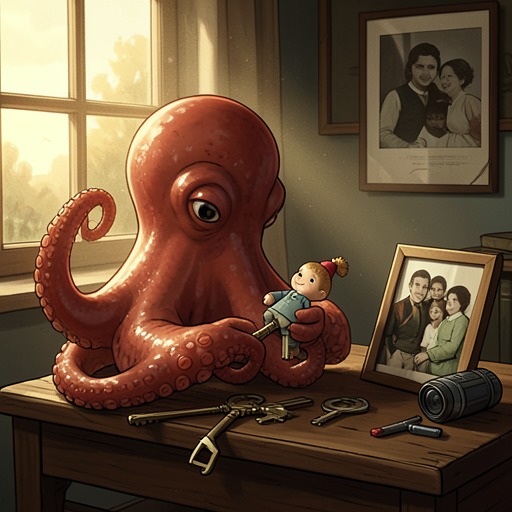
The key is Tova’s house key, lost the previous year. Marcellus comes across it on the floor near the place where Tova keeps her belongings while she cleans. Although keys have become ordinary finds in his long captivity, this one catches his attention. He takes it to his tank and hides it in a deep pocket of his hollowed-rock den, among a collection of objects that includes marbles, toys, cards, a driver’s license, a barrette, a ring, and a human tooth.
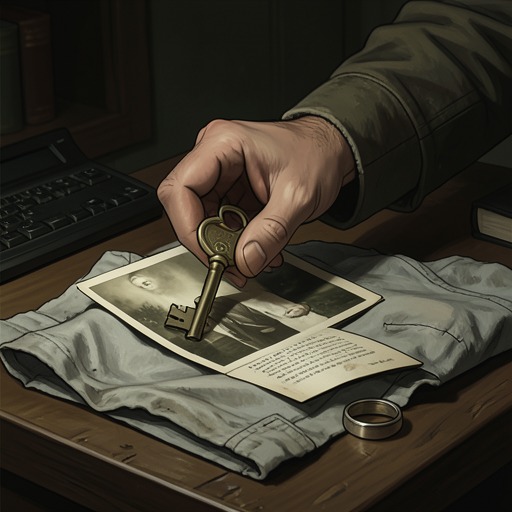
The key’s material condition marks its time away from Tova: when she gets it back, rust covers it. A baking-soda scrub removes most of the rust, and the cleaned key fits her front door smoothly. The object is thus not merely returned but tested against its purpose. Its successful fit confirms that, despite its appearance and unknown journey, it remains the working key to her home.
Recognition Beneath the Sea
Marcellus’s reason for keeping the key is not initially clear even to him. Later, running an arm over its ridges, he recognizes that he has encountered an exactly matching key before. He recalls finding a copy attached to a circular ring at the bottom of the sea, before his capture. The underwater find lay among remnants he describes as human belongings rather than bones or flesh: a rubber sneaker sole, a vinyl shoelace, and several plastic buttons, swept together beneath rocks.
The match does not prove who owned either key. Marcellus reasons that the submerged key and objects must belong to the person Tova mourns, but the distinction between a key and its copy matters: as he observes, keys can be duplicated. The resemblance makes the objects a compelling connection, not a definitive identification. The submerged remains give the returned key an undertow of possible family history, while leaving the precise link unresolved in this passage.
Return and Consequences
Marcellus offers the key to Tova, turning an object he had quietly taken and kept into a gift. His act is informed by the recognition that it resembles the key he found beside the underwater belongings, and by his sympathy for Tova’s loss. Returning it is his small, practical response to that grief: he cannot bring back what the sea has kept, but he can give her the key he found in her home.
Tova puts the recovered key back into use. After cleaning it, she restores it to its rightful place on her keyring and removes the spare, which has sometimes caught in the lock. She tosses that troublesome duplicate into the kitchen junk drawer. The exchange reverses the keys’ positions in her everyday life: the recovered original works smoothly, while the spare becomes the discarded, inconvenient one. The moment briefly makes an ordinary household object newly conspicuous—not because it fails, but because its return reveals how much unseen history may be attached to something as familiar as a key.